|
| |
| Unter diesem Verzeichnis -- http://esommer.net/d/ -- befindet sich das deutschsprachige Angebot von esommer.net |
|
|
|
|
 expand all | collapse all expand all | collapse all
about the tech behind this website
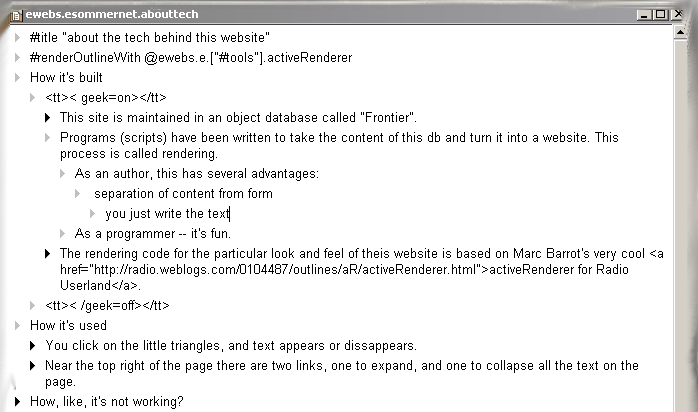
 | How it's built |
| < geek=on> |
| This site is maintained in an object database called Frontier. |
 | "object" database means that the atomic addressable elements of the db aren't just scalar types, like strings, but can be objects such as outlines. it's probably no big deal, you could emulate the same thing in any relational db -- the big deal to me as author is that Frontier comes with certain types of objects readymade, and a UI to browse them, and a scripting language to manipulate them. |
| so i write some text, usually in an outline, because i've been thinking them for a large part of my life that i can remember, then i click a button, e presto, i have a website. |
| Programs (scripts) have been written to take the content of this db and turn it into a website. This process is called rendering. |
| As an author, this has several advantages: |
| separation of content from form |
| you just write the text. all the colors and context are handled by the machine. you can write html tages right into the text, but you don't have to. |
| .. more, just not right now, gotta work |
| As a programmer -- it's fun. |
| i use the word "based" above mainly to gratuitously pat myself on the back -- i didn't actually have to change very much to get it to work in Frontier's static website framework. |
| < /geek=off> |
| How it's used |
| You click on the little triangles, and text appears or dissappears. |
| You've probably figured this out already, since you are reading this. sorry! |
| Making text appear is called expanding. |
| Making it dissappear is called collapsing. |
| Near the top right of the page there are two links, one to expand, and one to collapse all the text on the page. |
| nifty, or what! |
 | How, like, it's not working? |
| This website is rendered to a form that makes use of javascript, css and DHTML elements. |
| DHTML stands for dynamic html, which to me means mainly that the page can change its appearance after it has been loaded into your bowser. |
| The term Dynamic HTML has been bounced around, with different meanings, since the Web's inception. Originally, it was used to describe the customized pages generated by Server Side Includes. |
| .. |
| Today Dynamic HTML refers to technologies that allow documents to be changed after their initial display, without server access, through user interaction and client-side scripting. Page elements can be displayed selectively, then modified, moved or replaced. |
| Marc writes (frozen in time 20030319): |
| Pages rendered by activeRenderer rely on CSS styling and a little Javascript to make the collapse/expand/include features common to outliners available directly in the Web browser. |
| The resulting DHTML code works well with most recent, standard compliant web browsers. It has been tested succesfully with MSIE 5/6 and Mozilla. |
| Opera, OmniWeb and Safari fans should wait for their favorite browser to make progress on the CSS and Javascript front. |
| i think it looks very cool because of this, but unfortuneately not all browsers display it correctly. Mozilla and Internet Explorer do, in their newer versions, but my favorite, Opera, does not, which causes me much sorrow. i really hate it when sites require specific browsers. It's pretty stupid, actually, because you want your site to be read, right? So i tell myself, it's not that this site requires a specific browser -- just one that is on the bleeding edge of standards compliance. Doesn't it sound better when you put it that way? |
expand all | collapse all
|
.
.
.
.
.
home
.
english
.
deutsch
.
siteindex
.
.
.
.
.
.
.
.
.
.
.
.
.
.
|